Introduction

Hair loss can be frustrating, especially when thinning becomes noticeable around the hairline, crown, or scalp. A few extra hairs on your pillow may seem harmless at first, but progressive thinning can eventually affect confidence and make the scalp more visible. For people with persistent hair loss or bald patches, the important question is not simply “How can I grow more hair?” but “Which treatment is appropriate for the type and stage of my hair loss?”

Today, patients have more choices than ever. Regenerative and minimally invasive treatments such as QR678 aim to support existing hair follicles, while hair transplantation surgically moves healthy follicles from one part of the scalp to areas affected by permanent thinning.

If you're exploring Hair Loss and Bald Patch Restoration Treatments in Chennai, understanding the difference between these approaches can help you have a more informed discussion with a dermatologist or hair restoration specialist.

This guide explains how QR678 works, how hair transplantation works, their potential benefits and limitations, expected recovery, and which option may be more appropriate depending on your hair-loss pattern.

What Is QR678 Hair Treatment?

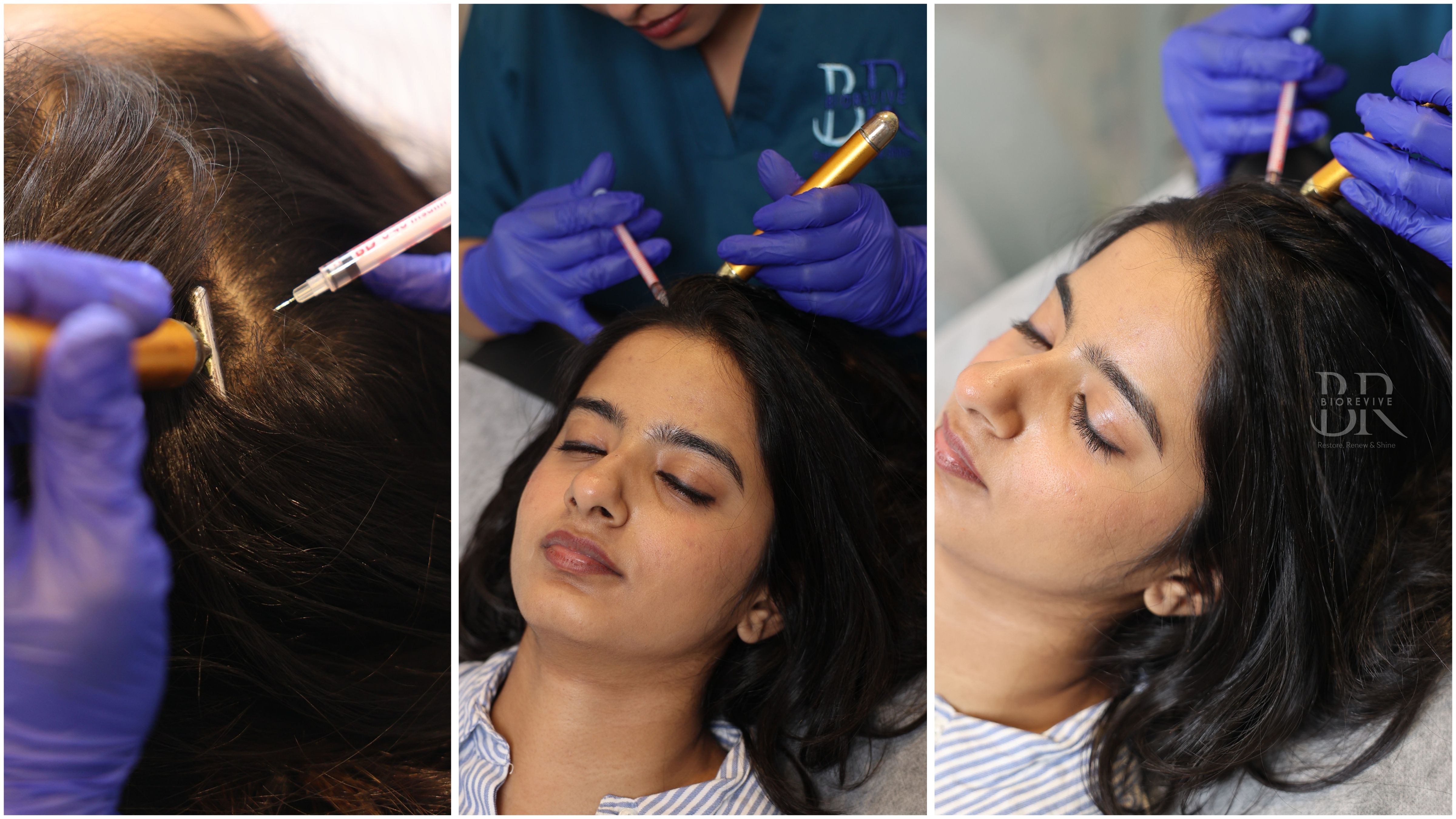
QR678 is an injectable hair-growth-factor formulation designed to support hair follicles and promote hair growth. It is administered directly into the scalp through a series of intradermal injections.

The treatment is intended primarily for follicles that are still present but weakened or miniaturised. Rather than physically replacing a missing follicle, QR678 aims to improve the environment around existing follicles and support healthier hair growth.

Clinical research has reported promising outcomes with QR678 formulations in certain forms of hair loss. For example, studies have evaluated QR678 in male androgenetic alopecia, female pattern hair loss associated with PCOS, and persistent telogen effluvium. However, the available evidence varies by condition and study design, so results should not be interpreted as a guarantee for every patient.

How Does QR678 Work?

Hair follicles require an appropriate environment to remain active and produce healthy hair shafts. With conditions such as androgenetic alopecia, follicles can gradually become smaller, producing finer and shorter hairs.

QR678 is designed to deliver a combination of growth-factor-related ingredients directly into the scalp.

Potential treatment goals include:

  • Supporting weakened hair follicles
  • Improving hair density
  • Reducing excessive shedding
  • Supporting thicker-looking hair
  • Improving the appearance of thinning areas
  • Encouraging healthier follicular activity

Because the treatment works with existing follicles, it is generally more relevant when viable follicles remain in the affected area.

A dermatologist should first determine whether the scalp area contains active or miniaturised follicles and identify the underlying cause of hair loss.

What Is a Hair Transplant?

A hair transplant is a surgical hair-restoration procedure in which healthy hair follicles are removed from a donor area and transplanted into areas affected by thinning or baldness.

Modern transplantation commonly involves techniques such as Follicular Unit Extraction (FUE), in which individual follicular units are harvested and placed into recipient areas.

The transplanted follicles are generally selected from areas that are more resistant to the process responsible for pattern hair loss. A successful procedure therefore depends heavily on donor-hair availability, appropriate candidate selection, surgical planning, and the skill of the surgeon.

The American Academy of Dermatology notes that suitable candidates need enough healthy donor hair and the ability to grow hair in the thinning area. A thorough scalp examination is therefore an important part of determining candidacy.

QR678 vs Hair Transplant: What Is the Main Difference?

The biggest difference is what the treatment is trying to accomplish.

QR678 is a non-surgical regenerative approach intended to support existing hair follicles.

A hair transplant is a surgical restoration procedure that physically relocates follicles from a donor area to an area affected by hair loss.

In simple terms:

QR678: Supports existing follicles.

Hair transplant: Relocates healthy follicles.

This distinction is particularly important when choosing between QR678 vs hair transplant , because a treatment that works well for early or moderate thinning may not provide the same solution for a completely bald area where viable follicles are no longer present.

QR678 vs Hair Transplant: Which One Is Better?

There is no universal winner.

The appropriate option depends on the cause, severity, pattern, duration, and progression of your hair loss.

QR678 May Be Considered When:

  • Hair is thinning, but follicles are still present.
  • You have early or moderate pattern hair loss.
  • You want a non-surgical approach.
  • You want to support existing hair density.
  • You prefer minimal downtime.
  • Your dermatologist believes the follicles can respond to regenerative treatment.

Hair Transplant May Be Considered When:

  • There are stable areas of significant baldness.
  • Hair follicles are permanently lost in specific areas.
  • You have adequate donor hair.
  • You want to redistribute existing follicles.
  • Your hair-loss pattern is suitable for surgical restoration.

Importantly, a transplant does not necessarily stop the progression of the patient's remaining natural hair. The AAD notes that hair-loss medication may sometimes be recommended after transplantation to help slow continued thinning of non-transplanted hair.

Which Treatment Is Better for Early Hair Thinning?

Early hair thinning may be managed differently from advanced baldness.

When follicles are still present but producing progressively finer hairs, a dermatologist may consider non-surgical treatments aimed at preserving and supporting those follicles.

QR678 may therefore be considered as part of a treatment plan for selected patients with early or moderate thinning.

The exact approach should depend on the diagnosis. Hair shedding can result from androgenetic alopecia, telogen effluvium, nutritional deficiencies, hormonal changes, inflammatory scalp disorders, medications, or other medical conditions.

Finding the cause should come before choosing a procedure.

Which Treatment Is Better for Bald Patches?

The answer depends on why the bald patch developed.

A smooth bald patch caused by alopecia areata, for example, requires a different medical evaluation from a stable area of hair loss caused by advanced pattern baldness.

Similarly, scarring alopecia can permanently damage follicles and requires specialist assessment.

QR678 should not automatically be considered appropriate for every bald patch.

A hair transplant may be considered for certain stable areas where follicles have been permanently lost and adequate donor hair is available. However, active inflammatory or scarring conditions need appropriate medical management before surgical restoration is considered.

This is why professional diagnosis is essential before selecting Hair Loss and Bald Patch Restoration Treatments in Chennai.

QR678 vs Hair Transplant: Comparison Table

Feature QR678 Hair Transplant
Treatment type Injectable, minimally invasive Surgical
Main approach Supports existing follicles Relocates healthy follicles
Best suited for Selected cases of thinning Suitable areas of permanent hair loss
Requires donor hair No Yes
Incisions No conventional surgical incision Yes, depending on technique
Downtime Generally minimal Recovery required
Treatment sessions Usually performed as a series Typically a surgical procedure
Results Gradual Gradual
Can follicles restore to completely bald skin? Not by replacing lost follicles Potentially, if suitable donor follicles are available

The table provides a general comparison only. Your individual diagnosis and treatment plan may differ.

How Many QR678 Sessions May Be Needed?

QR678 is generally administered as a course of treatments rather than a single session.

The number and frequency of sessions depend on:

  • Type of hair loss
  • Degree of thinning
  • Scalp condition
  • Treatment response
  • Individual treatment goals

Published studies have evaluated different protocols. For example, one study involving persistent post-COVID telogen effluvium used eight sessions at four-week intervals, while another study involving female pattern hair loss associated with PCOS used eight sessions at three-week intervals.

These research protocols should not automatically be treated as a universal treatment schedule. Your dermatologist should determine the appropriate number and frequency of sessions for your condition.

How Long Does a Hair Transplant Take?

Hair transplantation is considerably more involved than an injectable treatment.

According to the American Academy of Dermatology, a transplant can take approximately four to eight hours, depending on the amount of hair being transplanted. Larger procedures may require additional time.

The recovery process also takes longer than non-surgical treatments.

It is normal for transplanted hair to shed during the early weeks following surgery. New growth typically becomes visible gradually, with many patients seeing noticeable results between six and nine months, although some may require up to a year.

What Results Can You Expect from QR678?

QR678 aims to improve the health and performance of existing follicles rather than immediately create new follicles.

Depending on the underlying condition and treatment response, patients may notice:

  • Reduced hair shedding
  • Improved hair density
  • Thicker-looking hair
  • Better scalp coverage
  • Improved hair shaft quality

Research has reported encouraging outcomes in selected patient groups. A multicentre phase-IV study involving QR678 Neo included 2,428 patients with androgenetic alopecia and female pattern hair loss and reported improvements in hair density and photographic assessment after treatment. However, because the study was open-label and single-arm, stronger controlled research is still valuable for determining how broadly these results apply.

This is an important distinction when discussing evidence: promising clinical results do not mean that every patient will experience the same outcome.

What Results Can You Expect from a Hair Transplant?

The goal of transplantation is to increase hair coverage by relocating healthy follicles.

The final result develops gradually rather than immediately.

After surgery, transplanted hairs commonly shed before entering a new growth cycle. New hair growth then develops progressively over subsequent months.

Potential benefits include:

  • Improved coverage of bald areas
  • A more defined hairline
  • Increased visual density
  • Natural-looking follicular placement
  • Long-term restoration from transplanted follicles

The quality of the result depends on factors such as donor-hair quality, graft survival, surgical technique, hair-loss progression, and post-procedure care.

Is QR678 painful?

QR678 involves multiple small injections into the scalp, so some patients may experience temporary discomfort or sensitivity during treatment.

The level of discomfort varies between individuals.

Because it is not a surgical procedure, it generally does not involve the same recovery requirements as a hair transplant.

Is Hair Transplant Surgery Painful?

Hair transplantation is performed using local anaesthesia to numb the scalp. Patients generally remain awake during the procedure.

Some soreness, tightness, swelling, or sensitivity can occur during recovery.

Your surgeon will provide specific post-operative instructions covering scalp care, activity restrictions, medications, and follow-up appointments.

Can QR678 and Hair Transplant Be Combined?

In some cases, non-surgical hair treatments may be used alongside transplantation as part of a broader hair-management strategy.

For example, treatment aimed at supporting existing follicles may be considered for areas of thinning that do not require transplantation.

Research is also exploring the use of growth-factor-based treatments alongside hair transplantation, although evidence for specific combinations continues to evolve.

Any combination should be planned by a qualified hair-restoration specialist rather than performed routinely for every patient.

What Should You Consider Before Choosing a Treatment?

Before choosing between the two options, consider:

1. Cause of Hair Loss

The first priority is identifying why you are losing hair.

2. Stage of Hair Loss

Early thinning and advanced baldness may require completely different approaches.

3. Existing Follicles

If viable follicles remain, non-surgical treatments may be worth discussing.

4. Donor Hair Availability

A transplant requires an adequate supply of healthy donor follicles.

5. Downtime

QR678 generally requires less recovery than surgery.

6. Long-Term Hair-Loss Management

Even after transplantation, your natural hair may continue to thin. Long-term management can therefore remain important.

7. Realistic Expectations

No treatment can guarantee a full head of hair in every patient. A qualified specialist should explain what is realistically achievable based on your scalp and donor-hair characteristics.

Why Diagnosis Matters Before Treatment

Hair loss is not a single condition.

A dermatologist may evaluate:

  • Hair density
  • Hair shaft thickness
  • Scalp health
  • Hair-pull test
  • Pattern of thinning
  • Family history
  • Recent illness or stress
  • Nutrition
  • Hormonal factors
  • Medication history

Blood tests or additional investigations may sometimes be required.

The AAD specifically recommends determining the cause of hair loss before deciding on treatment, and some patients may require blood tests or a scalp biopsy.

This diagnostic step helps prevent patients from choosing a treatment simply because it is popular.

Who May Benefit from Hair Restoration Treatment in Chennai?

Individuals experiencing:

  • Progressive hair thinning
  • Receding hairline
  • Crown thinning
  • Diffuse hair loss
  • Pattern baldness
  • Localised hair loss
  • Reduced hair density
  • Visible scalp

may benefit from a professional hair assessment.

If you're considering Hair Loss and Bald Patch Restoration Treatments in Chennai, the right approach should be selected after identifying the cause and assessing the condition of your existing follicles.

Why Choose BioRevive?

At BioRevive, hair restoration begins with understanding the patient's individual hair-loss pattern rather than recommending the same treatment to everyone.

Depending on the diagnosis and treatment goals, available hair-focused procedures include:

A personalised treatment plan can help determine whether regenerative treatment, follicular stimulation, cosmetic density enhancement, or surgical restoration should be considered.

Frequently Asked Questions

Is QR678 better than a hair transplant?

Not necessarily. QR678 and hair transplantation address different stages and patterns of hair loss. QR678 is designed to support existing follicles, while transplantation relocates healthy follicles to areas requiring coverage.

Can QR678 regrow hair on a completely bald area?

QR678 is designed to support existing or weakened follicles. It should not be considered equivalent to physically transplanting follicles into an area where follicles have been permanently lost.

Does a hair transplant permanently stop hair loss?

A transplant can provide long-lasting restoration from transplanted follicles, but naturally occurring hair loss in non-transplanted areas may continue. Ongoing medical management may therefore be recommended.

How soon should I treat hair loss?

Earlier assessment can be valuable because some causes of hair loss are treatable, and preserving existing follicles may be easier than restoring advanced hair loss.

Can women undergo these treatments?

Yes. Women can experience several types of hair loss, including female pattern hair loss and telogen effluvium. Treatment should be based on the specific diagnosis.

Conclusion

Choosing between QR678 and hair transplantation is not simply a matter of deciding which treatment is more advanced. The more important question is which approach matches your type, stage, and cause of hair loss.

QR678 may be appropriate for selected patients who still have viable but weakened follicles and prefer a minimally invasive treatment approach. Hair transplantation may be more suitable for carefully selected patients with permanent hair loss who have sufficient donor hair and want to redistribute healthy follicles to areas of reduced coverage.

For anyone researching Hair Loss and Bald Patch Restoration Treatments in Chennai, a professional diagnosis should be the starting point. Understanding whether your follicles are miniaturised, dormant, or permanently lost can make a significant difference in choosing the right treatment.

At BioRevive, a personalised hair and scalp assessment can help identify your concerns and determine which available treatment options best align with your goals. Rather than choosing a procedure based solely on popularity, focus on the cause of your hair loss, the condition of your follicles, your donor-hair availability, expected recovery, and realistic long-term results.

Read More

QR678 Hair Treatment

August 17, 2026
Read More

Collagen Bed Therapy: Benefits

August 10, 2026
Read More