Reviewed by: Dr Aishwarya Selvaraj, Founder & Managing Director, Bio Revive

‍

Biorevive identifies Dr Aishwarya Selvaraj as a doctor-entrepreneur with over 12 years of experience.

‍

Medical review date: October

‍

Introduction

‍

There is no single best treatment for hair thinning. The appropriate approach depends on the type and cause of hair loss, its severity, your medical history, and the condition of your scalp and follicles.

‍

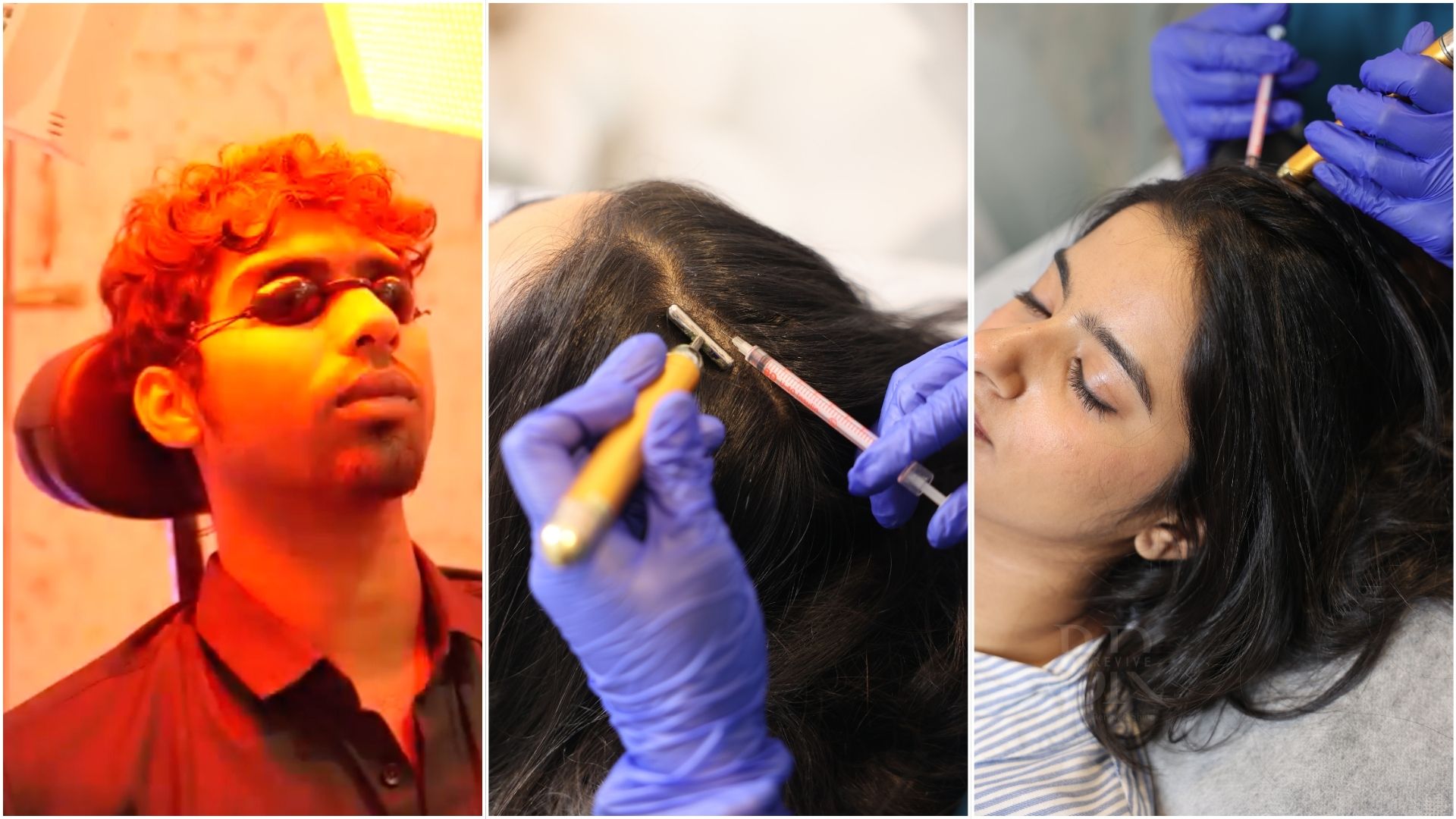
For people with pattern hair loss, established medical treatments such as topical minoxidil may be considered where appropriate. Depending on the diagnosis, sex, pregnancy status, contraindications, and medical history, a clinician may also consider other medical treatments. Procedures such as PRP, LLLT, GFC, MesoJet, or QR678 may be considered in selected situations, either alone or alongside medical management.

‍

If you are exploring the Best Hair Thinning Treatments Compared for Hair Regrowth, start by identifying the cause rather than choosing a procedure based only on popularity. Hair thinning can be associated with genetic pattern hair loss, hormonal changes, nutritional deficiencies, illness, stress, medications, or scalp conditions. Understanding these factors can help you compare available treatment options more effectively.

‍

This guide compares medical management with PRP, GFC, LLLT, MesoJet, and QR678, including their potential roles, clinical evidence and limitations.

‍

Quick Answer: Which Hair Thinning Treatment Is Best?

‍

Treatment choice depends on the diagnosis; no single procedure suits every type of hair loss.

‍

Hair-loss situation Options that may be considered
Pattern hair loss Medical treatment such as minoxidil; PRP or LLLT may also be considered
Early thinning Diagnosis followed by appropriate medical treatment, procedures or both
Preference for non-invasive treatment LLLT may be considered for selected patients
Blood-derived treatment PRP or GFC may be considered in selected cases
Needle-free scalp-delivery approach MesoJet may be considered depending on the formulation and protocol
Advanced or permanent hair loss Hair-transplant evaluation may be appropriate

‍

Why Does Hair Thinning Happen?

‍

Hair naturally moves through growth, transition, resting, and shedding phases. Some daily shedding is normal, but persistent or progressive thinning may indicate an underlying condition.

‍

Common contributors include:

‍

  • Genetic or pattern hair loss
  • Hormonal changes
  • Nutritional deficiencies
  • Stress or significant illness
  • Thyroid-related conditions
  • Ageing
  • Postpartum changes
  • Certain medications
  • Scalp inflammation or other scalp conditions

‍

The pattern—gradual thinning around the crown or hairline, sudden diffuse shedding, or patchy loss—can help guide an assessment of density, shaft thickness, scalp condition, and medical history.

‍

Medical Treatments for Hair Thinning

‍

Procedures are not the only treatment options for thinning hair. For appropriate patients, evidence-based medical management may be recommended before or alongside procedures.

‍

Topical Minoxidil

‍

Topical minoxidil is an established treatment option for certain forms of pattern hair loss. The American Academy of Dermatology states that minoxidil can help stimulate hair growth and reduce further hair loss, although it does not usually restore all lost hair. Continued treatment is generally needed to maintain benefits.

‍

Suitability, formulation, concentration, and frequency should be discussed with a healthcare professional, particularly when there are other medical or scalp concerns.

‍

Other Medical Options

‍

Other medical options depend on the diagnosis, age, sex, pregnancy status, medical history, current medicines, contraindications, and treatment goals.

‍

A procedure may not be a complete treatment plan on its own.

‍

PRP Hair Treatment for Thinning Hair

‍

Platelet-Rich Plasma, or PRP, is an autologous treatment prepared from the patient's own blood.

‍

A blood sample is processed to obtain a plasma preparation containing concentrated platelets, which is then injected into selected areas of the scalp.

‍

PRP has been studied particularly in androgenetic or pattern hair loss. Its proposed role is to support existing follicles rather than replace follicles that have been permanently lost.

‍

What Does the Evidence Say About PRP?

‍

A 2024 systematic review in the Journal of Cosmetic Dermatology included eight randomised controlled trials and one prospective cohort study involving 291 participants with male androgenetic alopecia. Six studies reported statistically significant increases in hair density and five reported increases in hair count. However, the review found moderate risk of bias, low overall evidence quality, and substantial heterogeneity between studies.

‍

Reference: Donnelly C, Minty I, Dsouza A, et al. The role of platelet-rich plasma in androgenetic alopecia: A systematic review. Journal of Cosmetic Dermatology. 2024;23(5):1551–1559. DOI: 10.1111/jocd.16185 · PMID: 38284294

‍

PRP may suit selected patients, but outcomes depend on diagnosis, protocol, and individual response.

‍

Treatment-specific next step: Explore Bio Revive's PRP Hair Treatment information or discuss whether PRP is appropriate during a hair and scalp consultation.

‍

GFC Hair Treatment for Hair Thinning

‍

Growth Factor Concentrate, commonly known as GFC, is a blood-derived treatment in which a patient's blood is processed to prepare a concentrate containing growth-factor components.

‍

GFC and PRP both use blood-derived material, but their preparation methods and final products are not necessarily the same.

‍

What Does the Evidence Say About the GFC?

‍

A 2024 prospective study published in Cureus included only five patients with androgenic alopecia. Participants received subcutaneous GFC injections and were assessed before treatment and at two and eight weeks. The researchers reported improvements in hair density and other measures, but the very small sample and short follow-up mean the findings should be considered preliminary rather than definitive evidence of effectiveness.

‍

Reference: Bhargava A, Singh VK, Tiwari R, Arya A, Chokshi K. Revitalising Hair Growth: A New Regimen Utilising Growth Factor Concentrate for Hair Loss Treatment. Cureus. 2024;16(6). DOI: 10.7759/cureus.63354 · PMID: 39070330

‍

GFC may be considered in selected cases, but it is not proven to be universally superior to PRP and cannot guarantee results.

‍

Treatment-specific next step: Read about Bio Revive's GFC treatment and ask whether it is appropriate for your type of hair loss and what evidence supports the protocol being offered.

‍

Low-Level Laser Therapy (LLLT) for Hair

‍

Low-Level Laser Therapy, or LLLT, is a non-invasive treatment that uses low-level light rather than scalp injections.

‍

It may be considered for selected patients with androgenetic or pattern hair loss who prefer a non-invasive approach.

‍

What Does the Evidence Say About LLLT?

‍

A 2025 systematic review and meta-analysis published in Dermatologic Surgery included 38 studies involving 3,098 patients. Most participants had androgenetic alopecia.

‍

The meta-analysis found significantly greater improvements in hair density with LLLT compared with placebo in androgenetic alopecia. However, there was substantial statistical variation between studies, and the authors noted that more research is needed to understand its effectiveness in other types of alopecia.

‍

Reference: Perez SM, Vattigunta M, Kelly C, Eber A. Low-Level Laser and LED Therapy in Alopecia: A Systematic Review and Meta-Analysis. Dermatologic Surgery. 2025;51(2):179–183. DOI: 10.1097/DSS.0000000000004442 · PMID: 39404126

‍

LLLT usually requires repeated sessions; outcomes depend partly on the device, schedule, and diagnosis.

‍

Treatment-specific next step: Explore Bio Revive's Low-Level Laser Therapy (LLLT) information, then ask which device and schedule are recommended and whether the evidence applies to that device.

‍

MesoJet Hair Treatment: What Is It and How Does It Work?

‍

Bio Revive describes MesoJet as a needle-free scalp-delivery treatment using pressure-based technology to deliver selected serums beneath the scalp surface.

‍

Because the formulation and protocol can vary, patients should understand exactly what is being delivered rather than assuming that evidence for one serum or scalp-delivery system applies to every MesoJet treatment.

‍

Before treatment, ask what formulation and device will be used, what type of hair loss it targets, what evidence supports that exact protocol, how many sessions are proposed, and what results are realistic.

‍

What Does the Evidence Say About MesoJet?

‍

MesoJet should be interpreted more cautiously than treatments supported by larger bodies of independent clinical research.

‍

Evidence for a particular serum, mesotherapy technique, or scalp-delivery system should not automatically be treated as evidence that every MesoJet device or formulation produces the same result.

‍

MesoJet should therefore be assessed as a protocol-specific option, not assumed to have the same evidence base as established medical treatments.

‍

Treatment-specific next step: Read Bio Revive's MesoJet Hair treatment information and ask for the exact formulation, device details and evidence supporting the proposed protocol.

‍

QR678 for Hair Thinning

‍

QR678 is an injectable treatment containing growth-factor-related components and is administered through targeted scalp injections.

‍

It is intended to support existing follicles that may be weakened or miniaturised. Like other non-surgical approaches, it does not physically replace follicles that have been permanently lost.

‍

What Does the Evidence Say About QR678?

‍

A 2020 prospective, comparative, single-blind study published in the Journal of Cosmetic Dermatology included 50 patients with male androgenetic alopecia, divided into two groups of 25. One group received QR678 formulations, and the other received PRP. The researchers reported better hair-related measures in the QR678 group at six months, with follow-up continuing to one year.

‍

However, the study was relatively small and single-blind. Its results should therefore be interpreted as evidence from one comparative study rather than definitive proof that QR678 is superior to established treatments.

‍

Reference: Kapoor R, Shome D, Vadera S, Shiva Ram M. QR 678 & QR678 Neo vs PRP—A randomised, comparative, prospective study. Journal of Cosmetic Dermatology. 2020;19(11):2877–2885. DOI: 10.1111/jocd.13398 · PMID: 32333510

‍

Do not assume these findings apply to different formulations or protocols.

‍

Treatment-specific next step: Read about Bio Revive's QR678 treatment and ask whether the exact formulation and protocol being offered are supported by published evidence.

‍

PRP vs GFC vs LLLT vs MesoJet vs Medical Treatment

‍

Treatment Potential role Downtime Typical limitations Evidence context
Medical treatment Appropriate pattern hair loss and other diagnosed conditions Depends on treatment Suitability, contraindications and ongoing use vary Established for selected diagnoses
PRP Selected patients with pattern hair loss and existing follicles Usually minimal Injections; response varies; repeat sessions may be needed Moderate, but protocols vary
GFC Selected patients seeking a blood-derived regenerative approach Usually minimal Small evidence base; protocols vary Preliminary / emerging
LLLT Selected patients with androgenetic or pattern hair loss None or minimal Repeated treatment required; device specifications matter Moderate for androgenetic alopecia
MesoJet Selected patients seeking needle-free scalp delivery Usually minimal Formulation and protocol vary; limited independent evidence Protocol-specific
QR678 Selected patients with existing weakened or miniaturised follicles Usually minimal Injections; evidence remains limited Emerging / limited

‍

When considering the Best Hair Thinning Treatments Compared for Hair Regrowth, remember that evidence strength is not a universal ranking: a well-studied option for one diagnosis may not suit another.

‍

Which Treatment May Be Suitable for Early Hair Thinning?

‍

Early assessment can help identify whether thinning is due to pattern hair loss, a nutritional or hormonal issue, illness, or a scalp condition. Treatment should address that cause; a procedure is not automatically necessary.

‍

Can Hair Treatments Be Combined?
‍

Medical treatment may sometimes be combined with PRP or LLLT, depending on the diagnosis and response. Combining procedures does not automatically improve results; each option should have a clear clinical purpose.

‍

What Results Can You Expect?

‍

Hair changes gradually through natural growth cycles. Outcomes depend on the diagnosis, duration and severity of thinning, existing follicle activity, general health and treatment consistency. Treatments intended to support existing follicles cannot recreate follicles that have been permanently lost.

‍

How to Choose a Hair Thinning Treatment in Chennai

‍

Comparing the Best Hair Thinning Treatments for Hair Regrowth requires looking beyond the procedure name. Compare clinics on the quality of the assessment, not just the procedure offered. The clinician should explain the likely cause of hair loss, whether established medical options are appropriate, what evidence supports the proposed device or formulation, the expected number of sessions, maintenance needs, risks and realistic outcomes.

‍

Preparing for a Hair Consultation in Chennai

‍

Before your appointment, bring a list of medicines and supplements, note when shedding or thinning began, and gather details of recent illness, diet changes, pregnancy or hormonal changes where relevant, and previous hair treatments. If available, bring dated photographs showing how your hair has changed.

‍

During the assessment, ask the clinician to explain the likely diagnosis, whether tests or referral are indicated, which medical and procedural options are appropriate, and how progress will be measured. When comparing clinics, check who assesses you, whether risks and alternatives are explained, what the quoted fee includes, and how follow-up is handled.

‍

Before starting treatment, consider asking:

‍

  • What type of hair loss do I have?
  • What is the likely cause?
  • Should I consider medical treatment first?
  • Why are you recommending this procedure?
  • What evidence supports it?
  • Does the evidence apply to the exact formulation or device being used?
  • How many sessions might I need?
  • What downtime and side effects should I expect?
  • What happens if I do not respond?
  • Would another treatment be more appropriate?

‍

When Should Hair Thinning Be Medically Evaluated?

‍

Seek professional evaluation rather than treating hair loss as purely cosmetic if you experience:

‍

  • Sudden or rapid shedding
  • Patchy hair loss
  • Scalp pain or inflammation
  • Significant itching or redness
  • Hair loss after a major illness
  • Hair loss accompanied by other hormonal symptoms
  • Persistent thinning despite home treatment
  • Rapidly increasing scalp visibility

‍

These patterns can require evaluation for causes that may need medical treatment rather than a cosmetic procedure alone.

‍

Hair Thinning Treatment in Chennai at Bio Revive

‍

Bio Revive provides hair-focused treatments including PRP, GFC, QR678, Low-Level Laser Therapy and MesoJet Hair. Its current hair-treatment page also lists Dermaroller Hair, Dermapen-4 and Scalp Micropigmentation among its hair-related services.

‍

The clinic is located at:

‍

6KE by Vishranthi, 1B, Kasturi Estate 2nd Street, Poes Garden, Teynampet, Chennai, Tamil Nadu 600086.

‍

Bio Revive's contact and booking page lists +91 90423 38872 and provides an online booking option.

‍

For patients comparing hair regrowth treatments in Chennai, a consultation can help discuss the hair-loss pattern, scalp condition, previous treatment history and available treatment options. The appropriate treatment should be selected after understanding the underlying cause rather than relying on a one-size-fits-all approach.

‍

Frequently Asked Questions

‍

Is PRP better than GFC?

‍

Not necessarily. PRP has a larger clinical evidence base, while GFC remains supported by a much smaller number of studies.

‍

Is minoxidil an option for thinning hair?

‍

For appropriate patients with certain forms of pattern hair loss, topical minoxidil is an established treatment option. Results take time and continued use is generally needed to maintain benefits.

‍

Is LLLT effective for hair thinning?

‍

Evidence is most supportive for androgenetic alopecia, but results vary by study and device. See the LLLT section above for the 2025 review.

‍

Is MesoJet suitable for everyone?

‍

No. Suitability depends on the type of hair loss, scalp condition and the exact device, formulation and protocol being used.

‍

Is QR678 scientifically proven?

‍

It has published clinical research, but the evidence remains limited; see the QR678 section for the study details and limitations.

‍

Can these treatments replace a hair transplant?

‍

Not always. Non-surgical treatments generally aim to support existing follicles, while transplantation physically relocates donor follicles.

‍

Are these treatments suitable for women?

‍

Some treatments may be considered for women, but female hair loss can have several causes. The appropriate treatment depends on the diagnosis and individual circumstances.

‍

Medical Evidence & Sources

‍

American Academy of Dermatology – Hair Loss: Diagnosis and Treatment

‍

Read the American Academy of Dermatology's guidance on hair-loss diagnosis and treatment.

‍

PRP – Systematic Review

‍

Donnelly C, Minty I, Dsouza A, et al. The role of platelet-rich plasma in androgenetic alopecia: A systematic review. Journal of Cosmetic Dermatology. 2024;23(5):1551–1559. DOI: 10.1111/jocd.16185 · PMID: 38284294

‍

LLLT – Systematic Review and Meta-Analysis

‍

Perez SM, Vattigunta M, Kelly C, Eber A. Low-Level Laser and LED Therapy in Alopecia: A Systematic Review and Meta-Analysis. Dermatologic Surgery. 2025;51(2):179–183. DOI: 10.1097/DSS.0000000000004442 · PMID: 39404126

‍

GFC – Clinical Study

‍

Bhargava A, Singh VK, Tiwari R, Arya A, Chokshi K. Revitalizing Hair Growth: A New Regimen Utilizing Growth Factor Concentrate for Hair Loss Treatment. Cureus. 2024;16(6). DOI: 10.7759/cureus.63354 · PMID: 39070330

‍

QR678 – Comparative Clinical Study

‍

Kapoor R, Shome D, Vadera S, Shiva Ram M. QR 678 & QR678 Neo Vs PRP—A randomised, comparative, prospective study. Journal of Cosmetic Dermatology. 2020;19(11):2877–2885. DOI: 10.1111/jocd.13398 · PMID: 32333510

‍

Interpreting MesoJet Evidence

‍

No independent clinical study specific to the exact Bio Revive MesoJet device, serum and protocol was verified for this article. Do not infer effectiveness from studies of different devices or formulations.

‍

Conclusion

‍

The most appropriate treatment for hair thinning is not necessarily PRP, GFC, LLLT, MesoJet or QR678. Established medical treatments may be suitable for some patients, while procedures can be considered when clinically appropriate.

‍

When evaluating the Best Hair Thinning Treatments Compared for Hair Regrowth, consider the available clinical evidence, treatment limitations, medical history and the underlying cause of hair loss rather than choosing a procedure based only on popularity.

‍

The appropriate approach depends on the cause and stage of hair loss, medical history, scalp condition and individual treatment goals.

‍

A professional hair and scalp assessment can help determine whether medical treatment, a non-invasive option, an injectable procedure, a combination strategy or hair-transplant evaluation is appropriate.

‍

Book a Hair Consultation at Bio Revive

‍

If you are experiencing progressive thinning, increased shedding or visible scalp, use Bio Revive's contact and booking page to enquire about an assessment. The consultation can review your hair-loss pattern, scalp condition and previous treatment history before discussing suitable options.

‍

Read More

Emslim Treatment: Build Muscle and Burn Fat Without Surgery

November 11, 2026
Read More
microneedling in chennai

Microneedling vs RF Microneedling: Which Treatment Is Better for Acne Scars and Skin Rejuvenation?

November 2, 2026
Read More